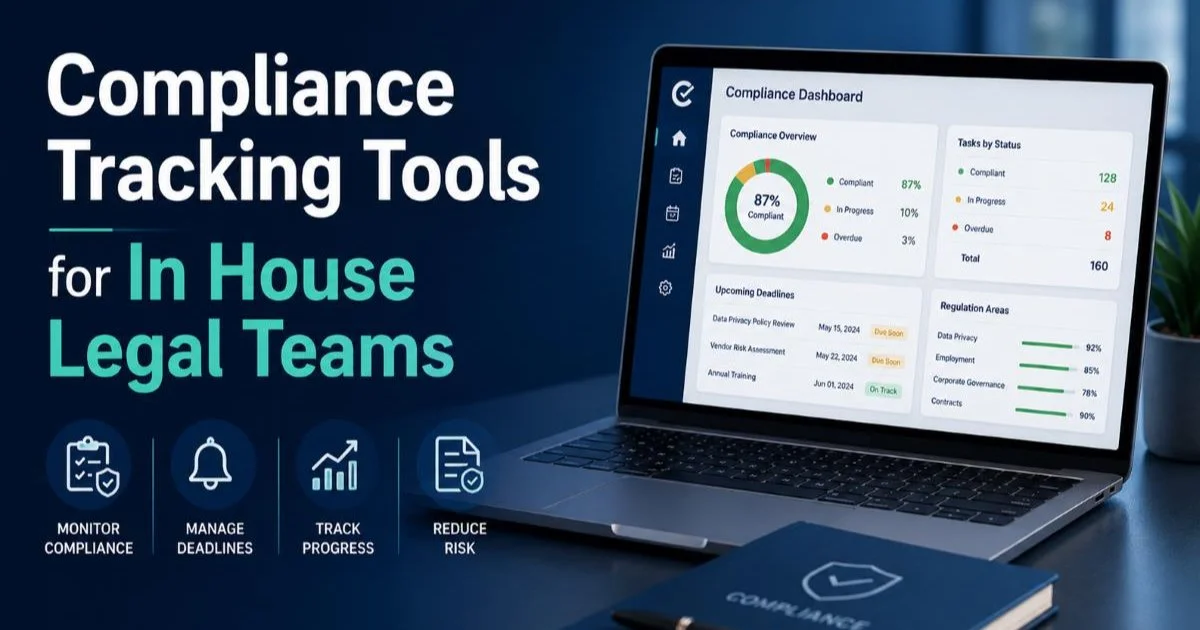
Compliance tracking tools for in-house legal teams have become a non-negotiable part of running a modern legal department. Regulatory requirements are multiplying across jurisdictions, industries, and business units, and the penalty for missing a deadline or failing an audit can be devastating.
Manual spreadsheets and email reminders worked a decade ago, but they simply cannot keep pace with today's obligations. In-house teams are expected to monitor hundreds of regulatory changes annually while managing contracts, policies, and internal governance.
The right compliance tracking tool can transform a reactive legal team into a proactive one. Choosing and implementing that tool, however, requires more than just purchasing software. This guide walks you through the specific steps to evaluate, deploy, and optimize compliance tracking tools for in-house legal teams so you can build a system that actually works.
Key Takeaways
- Map every regulatory obligation before selecting any compliance tracking tool.
- Prioritize tools that integrate with your existing contract management systems.
- Assign clear ownership for each compliance task to prevent accountability gaps.
- Automate deadline reminders and escalation workflows from day one of deployment.
- Review compliance metrics quarterly to identify patterns and reduce recurring risks.
Step 1: Audit Your Compliance Landscape
Identify Regulatory Sources
Before you touch any software, you need a complete inventory of what your team is actually tracking. This means listing every regulation, statute, contractual obligation, and internal policy that requires ongoing monitoring. Many in-house legal teams discover during this exercise that they have been relying on institutional knowledge rather than documented processes. Start by interviewing stakeholders across departments: finance, HR, procurement, IT, and product teams all carry compliance responsibilities that feed into legal operations workflows.
Pull data from your existing contract management system to identify recurring compliance clauses. Vendor agreements, employment contracts, and licensing deals often contain audit rights, reporting deadlines, and certification requirements that get lost after signing. Document every obligation in a central register, even if it currently lives in someone's inbox. This register becomes the foundation for everything that follows.
Categorize Obligations
Once you have your inventory, group obligations by type, jurisdiction, business unit, and frequency. A data privacy requirement under GDPR behaves differently than an environmental reporting deadline under EPA regulations. Categorization helps you understand which obligations cluster together, which are high-risk, and which can share workflow templates inside your tracking tool. Most legal teams find that 60% to 70% of their obligations fall into five or six categories.
Assign a risk rating to each obligation. A missed SEC filing carries different consequences than a late internal policy review. This risk-based approach allows your team to allocate resources where they matter most. It also helps justify the investment in compliance tracking tools for in-house legal teams to leadership by quantifying exposure.
Create a simple three-tier risk matrix (high, medium, low) based on financial penalty exposure and reputational impact for each obligation.
Step 2: Evaluate and Select the Right Compliance Tracking Tools
Features That Matter Most
Not all compliance tools are created equal, and the best choice depends on your team's size, industry, and existing technology stack. At minimum, look for automated deadline tracking, task assignment and escalation workflows, audit trail functionality, and reporting dashboards. Integration capability is especially important: your compliance tool should connect to your document organization systems and contract repositories without requiring manual data entry.
Security should be a top priority when evaluating any legal technology platform. In-house teams handle sensitive regulatory data, privileged communications, and personal information. Review each vendor's web application security best practices and ask specifically about encryption standards, access controls, and SOC 2 compliance. A tool that creates new vulnerabilities defeats the purpose of managing risk.
Never select a compliance tool based solely on feature lists. Request a sandbox environment and test it with real workflows before committing.
Comparing Tool Types
The market offers three broad categories of tools: dedicated compliance management platforms, legal operations suites with compliance modules, and customizable project management tools adapted for compliance. Each has distinct advantages depending on your situation. Dedicated platforms like Compliance.ai or LogicGate offer deep regulatory intelligence but may be overkill for smaller teams. Legal operations suites provide broader functionality across contract management, matter tracking, and compliance in a single interface.
Whichever route you choose, verify that the tool supports your specific compliance requirements. A tool designed for financial services compliance may lack features needed for healthcare HIPAA tracking. Ask vendors for references from companies in your industry and of similar size. Real-world testimonials reveal more than any demo.
Step 3: Implement and Configure Your System
Build Your Compliance Framework
Implementation is where most teams stumble. The technology is only as good as the framework you build inside it. Start by importing your obligation register from Step 1 and mapping each item to a workflow template. Define who owns each task, what the deadlines are, how escalation works when tasks are overdue, and what evidence must be captured for audit purposes. This is detailed, tedious work, but it is the difference between a tool that gathers dust and one that drives real accountability.
Create standardized naming conventions and taxonomy from the outset. Legal document organization breaks down quickly when different team members label the same obligation type in different ways. Establish clear rules for how items are categorized, tagged, and archived. Train every user on these conventions before the system goes live, not after confusion has already set in.
Plan for a 30 to 60 day parallel running period where you operate both your old system and the new tool simultaneously to catch any gaps.
Integrate With Existing Workflows
Your compliance tracking tool should not exist in isolation. Connect it to your contract management platform so that compliance obligations embedded in agreements automatically generate tracking tasks. Link it to your company's calendar and communication tools so deadline reminders reach the right people through channels they actually monitor. If your organization has accessibility requirements for internal tools, consult a resource like the WCAG compliance checklist to verify the tool meets those standards.
Establish clear escalation paths that involve both legal and business stakeholders. When a compliance task is overdue by 48 hours, the system should automatically notify the task owner's manager. At 72 hours, it should alert the general counsel or compliance officer. This kind of automated escalation removes the awkwardness of personal follow-ups and creates a culture of ownership across the organization.
Step 4: Monitor, Measure, and Improve
Track Key Performance Indicators
Once your system is running, resist the temptation to declare victory and walk away. The real value of compliance tracking tools for in-house legal teams emerges over time as you collect data on task completion rates, response times, and recurring bottlenecks. Build dashboards that show on-time completion percentages, overdue task counts by department, and average time to close compliance items. These metrics tell a story about your team's operational health.
Share these metrics with leadership on a quarterly basis. Concrete data showing that your team completed 97% of regulatory filings on time, or that overdue tasks dropped by 40% after implementation, builds credibility and justifies continued investment. Numbers speak louder than anecdotes when it comes to budget conversations with the C-suite.
"The teams that treat compliance tracking as a data problem rather than a paperwork problem consistently outperform their peers."
Iterate Based on Data
Review your compliance framework every quarter. Regulations change, business operations evolve, and the tool configuration that worked six months ago may no longer fit. Look for patterns in your data: if a particular department consistently misses deadlines, the problem may be unclear ownership rather than willful neglect. If a specific obligation category has a high error rate, the workflow template may need refinement or additional training.
Solicit feedback from all users, not just the legal team. Business stakeholders who interact with compliance tasks often have practical insights about what works and what creates friction. Use this feedback loop to refine notification timing, simplify approval chains, and eliminate unnecessary steps. The goal is a system that people actually use willingly, not one they work around. Continuous improvement is what separates functional compliance management from a glorified to-do list.
Set a recurring calendar event for the first week of each quarter specifically for compliance system review. Treat it like an audit of your audit system.
Frequently Asked Questions
?How do I build a compliance obligation register from scratch?
?Can compliance tracking tools replace our existing contract management system?
?How long does it realistically take to implement a compliance tracking tool?
?Is missing deadlines really more common than substantive compliance violations?
Final Thoughts
Implementing compliance tracking tools for in-house legal teams is not a one-time project; it is an ongoing discipline that compounds in value over time. The steps outlined here, from auditing your landscape to iterating based on real data, form a repeatable framework that adapts as your regulatory environment shifts.
Start with a thorough inventory, choose technology that fits your actual needs, and commit to measuring results honestly. The teams that build these habits protect their organizations from risk while freeing themselves to focus on higher-value strategic work.
Disclaimer: Portions of this content may have been generated using AI tools to enhance clarity and brevity. While reviewed by a human, independent verification is encouraged.